Friday, 8 August 2008

Tantalisingly close

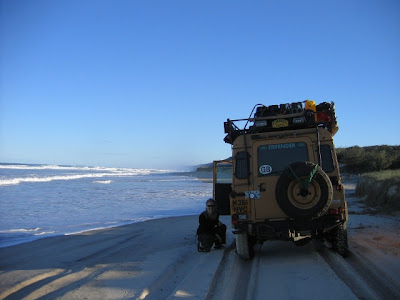
Camping right on Teewah Beach, right beside the Pacific Ocean, it started to sink in just how close we are now to the end of the journey. New Zealand is only 2000km away now. We have been listening to Radio New Zealand on short wave, and even heard my home town of Warkworth mentioned in the news the other day (because of a landslip in The Dome).

The sand dunes at Teewah were a great camping spot, and luckily we had a bit more room for the drive out along the beach the next day, instead of just the single lane width above the lapping waves of the previous evening.


All of our focus was now turning to shipping the Land Rover to New Zealand. This included sorting out shipping details as well as preparing the vehicle for entry to New Zealand. We had begun contacting shipping companies a couple of weeks ago, but still needed to arrange loading. Most importantly we needed to get on with cleaning the vehicle, and there were numerous small repair jobs I needed to sort out. We spent our last two nights camping in a forest park an hour or so north of Brisbane and spent the whole day touching up paint and attending to small repairs.

From there it was only a short run to my uncle’s place on Bribie Island, where we are staying until we fly out next week. Helen and Uncle David have had their driveway taken over by the Land Rover, and we have used up all their rainwater cleaning the vehicle from bottom to top to bottom again, inside and out.

Uncle David’s workshop and years of experience as a mechanic have been put to good use fixing everything that needed fixing, including re-welding our leaking front diff. He’s a Ford and Jeep man through and through, but secretly knows his way around a Land Rover pretty well also.


The thorough cleaning carried out before shipping from South Africa and on arrival to Fremantle meant that this time ’round the job was ten times easier. After three full days the Land Rover is looking a million bucks again, and all the little (and some not so little) repairs are complete. Hopefully the vehicle is clean enough to satisfy the New Zealand Ministry of Agriculture and Forestry officials and the Land Transport Safety Authority entry certifiers. We’re both pretty nervous about those two steps to importing the land Rover to New Zealand.


Over the weekend we took a run into Brisbane and caught up with Dr John, a friend that Catkin worked with on the ski fields in Queenstown a few years ago. It was good to see him again, and he and his family kept us well entertained while feeding us pizza for dinner. John was off to Mongolia the next day for a few weeks, so we got to play travel agent and make all sorts of suggestions about things to see and do there.


Yesterday we packed the car into a container for the second time on the trip. We decided to try it with the roof tent still on, and it just fitted in (just!). After chocking the wheels and lashing it in, we closed the container doors and sealed it. Hopefully we will see the Land Rover again in ten days or so, all going well.


In the eight weeks since leaving Perth we have covered almost 12,000km in Australia, bringing our total for the trip so far to about 56,000km. Diesel prices have been the highest on record, and in some of the more remote places has been the most expensive we have had to buy anywhere on our whole trip so far. All this has lead to nearly half our total fuel costs being spent on less than a quarter of the total journey. Only now that we have finished the Australian leg of the journey have fuel prices started to come down.

Everyone has been eagerly anticipating the start of the Olympics, but this auspicious date 08.08.08 just happens to be my Mum’s birthday, so Happy Birthday Mum! Mum has been counting off the days until we get there - not long to go now.

Wednesday, 30 July 2008

Nearly there now

A place with a name like Coober Pedy certainly had us intrigued and after learning that most of the living is done underground we decided to visit, it was even on our way. One teenage lad had told us that the town was really spectacular and although we learned a long time ago not to set too much store by other people’s impressions, we came away with a decidedly different impression. The town really is rather bizarre. The locals are very proudly displaying recent photos taken of the surface of Mars and comparing them to photos of their beloved town. We had to agree that they are very similar, except that Coober Pedy is probably a bit more dusty. The town is the centre of the Opal mining industry and every other premises is either an old mine museum or Opal shop. The original pioneers and miners decided that the environment was a little too hot for them and being miners burrowed underground to live and today many of these dwellings house commercial premises and hotels. It was lovely to go down into the cave like rooms, they must have been a real sanctuary from the wind, dust and heat.


Dotted all round the town are many small private mining ventures and there are numerous signs warning of the potential dangers.


After the usual fuel and water top up we took a road eastwards to William Creek to meet up with the Oodnadatta track. For the first time on the whole trip we had to pay for the water which is dispensed from a coin operated machine. Water is fairly precious in these parts, although it did only cost a few cents.

We were by now rather wary of gravel roads but were very pleasantly surprised. This one was almost, not quite, as smooth as a baby’s bottom. What a delight. The road itself was also a lot more interesting than the Tanami track. The next day we expected that on meeting up with the Oodnadatta track we would again be met by huge corrugations, but again the road was good. In fact none of the roads we have travelled on since have been nearly as bad as we feared. What a bonus.

The Oodnadatta track follows part of the route of the Old Ghan Railway, which travelled from Adelaide to Darwin. All along the part we travelled were a number of sidings and homesteads some in a completely ruined state and some restored. One even hosts a ball on alternate years. We encountered a sandstorm in the afternoon so I hope the ball is scheduled for a different season. We also drove through the world’s largest cattle station, Anna Creek, which is larger than Belgium. We did not see a single cow.


We stopped for a few drops of fuel in Leigh Creek before heading into the North Flinders Ranges. Leigh Creek is a modern mining town which has been fully landscaped and planned with all sorts of modern amenities (no bare patches of dust for the wind to agitate which gets into your nooks and crannies). It formed such a juxtaposition with the harsh environment and very different to the old fashioned homesteads and roadhouses we had passed.

That evening we found a site to camp which we hoped would provide us with enough shelter from the wind, also rain was looking imminent. Usually we find that the wind dies down when the sun sets, but not on this occasion so it was pitch black by the time we made camp. Few hours later the wind decided to change direction and it sounded as if our tent would be torn to shreds. Gavin got up to see if he find could somewhere a bit more sheltered and before long I felt the whole car moving underneath me. It was rather cool, I felt a bit like the Queen of Sheba being transported around but I did get up also because when the tent is erected the driver is unable to see anything. Eventually we were settled in a more sheltered spot and spent the rest of the night quite peacefully.

The following day we were keen to explore the mountains on foot but it was still so windy that all the dust in the dry river courses was just swirling everywhere and it was in fact really unpleasant so we stayed in the car and carried on driving. That evening we joined up with the Strzelecki Track and camped at a hot springs nestled between low sand dunes. It was still windy. The following morning it was still so Gavin set about repairing another puncture and a few other repairs. One of our oldest tyres really has had it but we are determined to get the last few miles out of it- especially as we are still on gravel roads and not travelling very fast. I enjoyed the luxury of washing my hair with HOT water and attending to some laundry.

Despite the ever present wind becoming even stronger as the day progressed we decided to spend the rest of the day hiding from the wind and having a bit of a break from travelling. The next day we were on the road again, not really bright and early because it really is pretty cold in the mornings, and arrived in Innamincka. The route took us past the Moomba gas fields and we were intrigued to see signs for various camps and then saw just a few containers. The odd container had a satellite dish and one had a sign on it “Hotel California”. These were the accommodation blocks for the mining workers- a few containers dumped in the desert, most congenial living quarters. We understand that the workers are paid very well. Although we were still in the desert there was evidence of recent rains as we drove past swathes of yellow, white and purple flowers.


That evening we were driving on tar seal. This has good and bad points. The worst thing is that it is only a single track of tar seal so in the event of meeting a road train or a road train wanting to overtake we have to pull right off the road. Two normal vehicles travelling in opposite directions both pull off half way onto the gravel which is great when a stone flicks up from the other vehicle and chips your windscreen.

It seemed that quite rapidly the scenery was changing from desertscape to pastoral countryside and the following morning we awoke to the scent of camomile pasture and the stares of an inquisitive neighbour of the bovine variety. Now it seemed that the wind had abated, after a week, and rain was imminent.

That evening the rain started and did not cease for days. In the morning we stopped at a picnic area when a chap originally from Devon pulled up in his land rover and thus ensued another of many landy conversations. He was also very proud of his beast which was preserved for real off-road adventures, so I think he was bit put out when another chap pulled up in his car towing a caravan and exclaimed that had he known that this big yellow land rover (us of course) was just down the road he would have come and asked us for a tow rather than going to the local garage, without even glancing at the Devonians land rover.

As we carried on our way we were coming across towns every two or three hundred kilometres, towns which were also incrementally increasing in size as the price of fuel was decreasing. We drove through the heart of the Australian cotton growing industry with large dams attached to towns. These dams provided the towns with lovely waterfront parks and although the ecological effect of these dams on the river systems downstream is highly controversial there is no denying the beautifying effect they have on these cotton towns.

Bush camping becomes more and more difficult as the roads become busier and the population density increases so when we heard about a rural pub which encourages bush camping on its common that was almost on our way we could not pass up the opportunity of a draft beer without having to drive or make camp. We arrived at the pub and very welcoming it looked however, with all the rain we had just encountered our potential camping area looked less than inviting. MUD. As we were surveying the scene a chap waved to us indicating to go no further. He gingerly picked his way through the mud over to us, followed by another chap caked from head to foot on his left side with mud. He explained that there were a number of vehicles all bogged down and were waiting for a tractor to come and pull them out. Okay, so we gave that area a miss and carefully made our way over to another to survey and almost got stuck ourselves and decided to give the whole thing a miss. We eventually found a campsite much later after dark by an agricultural railway depot which amazingly even provided hot showers. There were only two houses there and nothing else.


As we got closer to the coast we stayed in a couple of really delightful National Parks campsites, they even provided firewood (wet) which gave Gavin the opportunity of baking scones. In a delightful rural area we called in to visit Virgil, a friend of Gavin’s, and his new family. He and all his extended family-in-law made us very welcome and it was lovely to sit round a family dining table again.

Our time in Australia is coming to an end so we are spending our last week on the road exploring the area north of Brisbane which is very pretty, lush and hilly. Yesterday we passed through Gympie, an attractive old railway town on our way to the Great Sandy National Park. Last night we camped on the beach, nestled in the sand dunes, after driving a few kilometres along the beach, cutting it a bit thin as high tide was nigh.

Finally, before I go, very happy 25th birthday to Kathryn.

Friday, 18 July 2008

The Red Centre

Crossing the border into the Northern Territory we had to adjust our watches by one and a half hours to the strangest time zone we have been to – now we are nine and a half hours ahead of GMT, and we have to remember to listen to the World Service news at half past the hour. Just before the end of our journey down the Tanami Road we again crossed over the Tropic of Capricorn, so are once again out of the tropics. The night time temperatures have fallen dramatically to suit – the other night it was 0.2ºC, so at least it wasn’t freezing. The weather reports on the radio seem to constantly remind us that the temperature in Darwin is double that around Alice Springs.

Our visit to Alice Springs just happened to coincide with the annual “Camel Cup” held in town. It started a few years back when two locals raced camels down the dry riverbed in the middle of town and has carried on ever since as a local fundraiser. It seems that it has become quite popular, and people come from all over Australia to see it. We could see people looking at our Land Rover with the big Camel Trophy stickers on the doors, and a couple of our neighbours at the campsite even came over and asked if we were involved in the racing – they all looked a bit disappointed when we told them we weren’t. We didn’t end up going to the races, but by all accounts it was a great day, except for the rider who fell off and broke her leg. It’s a long way down…

We only spent just over 24 hours in Alice Springs, but there were busy hours. As Catkin mentioned we headed into Repco to see about our punctured shock absorber, and that took a while to get nowhere. We also stocked up on groceries, filled up with diesel, caught up on emails, picked up a parcel from the UK that had arrived at the Post Office that very day, spent a couple of hours on Skype talking to family in New York, New Zealand and England and even had time to visit the Royal Flying Doctor Service headquarters. With all that done we made our way out of town into the West MacDonnell National Park and found a spot to camp. This park has lots of scenic water holes and gorges to visit, plus loads of bush camping sites. We spent a couple of days making our way through the park.


At one water hole that we stopped at we started talking to an Australian couple who were on their way to Darwin to visit friends. They were regaling us with stories of the places they had visited so far, and insisted that we visit Ayers Rock. The lady got out her camera and started showing me all her photos, asking if we had even seen such red sand. I didn’t have the heart to tell her that actually we’ve seen loads of it, both here and in Africa, but just nodded and complimented her photography.


At Glen Helen Resort we purchased a permit (for $2.20) to allow us to travel around the Mereenie Loop to King’s Canyon. The road was another rough, corrugated gravel road, so again we had a nice slow afternoon, taking in all the scenery. We have noticed that four wheel drive is recommended for any gravel roads here – the only reason seems to be for the corrugations. No bush camping allowed around this area, so we had to fork out $27 for an unpowered campsite in a dust bowl. At least it was another chance for a shower and to do some laundry.

King’s Canyon was pretty spectacular, and we had a good look around on the 6km canyon rim walk, which, as you may have guessed, circumnavigates the rim of the canyon’s towering cliffs.


From there, we headed to Australia’s tourist mecca, Uluru or Ayers Rock. It’s really noticeable that the numbers of overseas tourists here is far greater than in other areas we have been. Road signs are shown in a number of languages, and there are big signs reminding you to drive on the left. This seemed a bit odd in the middle of the country (how did you get this far if you didn’t know to drive on the left?) but lots of people fly in and pick up their rental car here I suppose.

The town of Yulara was purpose-built as a resort to host visitors to Uluru. The visitor’s centre had a great display on the history of the area and the flora and fauna found locally. You are allowed to walk to the top of Uluru, although the indigenous people prefer it if you don’t.

Further along the road are the domes of Kata Tjuta, which are in themselves quite impressive. You could probably sit there and take photos all day.


The favourite times for viewing are by far sunrise and sunset, and big viewing areas have been built at both for these times. We were at Uluru for sunset, just as the almost-full moon was rising.


So, our whistle-stop tour of the Red Centre is all but complete, and now we turn our attention more directly eastward, and closer to our final destination. It sounds like we cannot take any fruit or vegetables across the border into South Australia, so we may have to camp out for a day our two on the way to consume all our oranges, potatoes and butternut pumpkin.

Friday, 11 July 2008

The Real Hema Map Boy

We spent another night in a roadside rest area near the access road to the Bungle Bungles, some of these areas are quite nice and campfires are sanctioned, just sometimes the generators some people use to power their fridges or air-conditioning or ovens or I do not know what can be a bit intrusive until they are switched off. The next day we trundled into the metropolis of Halls Creek. Another quite pleasant outback town with everything we could want; mainly fuel and groceries but also a tyre repair service, but more of that later. We stocked up on some very expensive groceries - we are quite a long way from anywhere, also despite having heard about global increase in food prices over the last year on the radio, as we are still working in UK prices from 12 months ago.

Our plan from Halls Creek was to drive east to Old Halls Creek, a few kilometres along the road and site of the first old rush in Western Australia, then find a track marked on our map which would take us south to the Tanami road. This is a 1000km gravel road across the Tanami desert from Halls Creek to Alice Springs. After stopping off to view the “China Wall”, a six foot high and two foot wide perpendicular strata of white quartz poking up out of the ground, we found what we thought was the track, but this ended up at the bottom of a rather deep quarry now full of water. So we tried the next track. This just became more and more rough and after making slow progress that required the odd bit of marshalling by myself travelling at an average of 5km/hr it was just not worth the short cut. So we turned around. A few miles down the road we found a delightful place to camp, in fact my favourite camping spot so far in Australia, at Sawpit Gorge, where some river (actually flowing) cuts through the hills (or mountains if you are Australian). In the morning we enjoyed a wonderful wash, well away from the water edge, and a cool bathe before heading back to Halls Creek.


Unfortunately, just as we pulled into Halls Creek we heard the pshhhtttt of a tyre going flat. Oddly enough so far in Australia the car has caused quite a bit of attention. This is even more surprising given the large numbers of 4WD vehicles around and many highly customised and a lot more flash than ours. This occasion was no exception. As we were trying to quickly get the wheel replaced without being too obvious, a chap who turned out to be the local bobby turned up, very interested. By the time we were round to the other side of the car there was another admirer. However this was no ordinary admirer he was Hema Map Surveyor. He was very interested to hear about our fruitless endeavours the previous day. He had been trying to find the southern entrance off the Tanami road (where we would have popped out) the previous day and had given up. He then proceeded to offer us his complete collection of maps of Australia to download onto the laptop. How very useful. Thank you.

Having repaired so many punctures already we decided that Gavin should have a break and we would take it to the man with the equipment. Maybe alarm bells should have started ringing when he said that with these types of wheels (not split rims) the inner tube often tears when it comes out. None of Gavin’s have. Needless to say our fairly new inner tube ended up with a really big hole in it so it also had to be replaced. While he inspected the tyre for the cause of the puncture saying “well bloke I can’t see anything to cause a puncture here” he cut his finger on the bit of metal that caused the puncture, this did nothing to boost my confidence. However, it was soon all repaired and we were on our way again. The repair lasted for two days. The culprit of this subsequent puncture was bits of metal between the inner tube and the tyre from his workshop floor. Great job blokey, so Gavin got to be manly again after all repairing more punctures. Only this time he is sporting some very stylish headgear in honour of the large number of really pesky flies.


That night we camped at Wolfe Creek crater, not only was a particularly gory horror film based there (and no we have not seen the film, everybody asks) but it is also the world’s second largest meteorite crater. Although there is not really much to see, it is believed that it was originally 120 metres deep 300,000 years ago, we found it to be pretty impressive.


The following day we turned south off the Tanami road back onto the Canning Stock Route, the northern end where we would have come out. We carried on down for another day and a half just to see a bit of what we had missed before turning back at the Breadon Hills. It really is not the isolated track we had anticipated. During the first day we saw at least ten other vehicles and a similar number the next day. They are all travelling at twice the speed we are over the corrugations, one chap asked us why were driving so slowly toady, we just replied that we always travel so slowly, “oh”. I think it just means that we can appreciate everything so much more, after all we are not planning to return to the outback in a hurry so we may as well make the most of it. It is interesting because we can see what animals are around by identifying their tracks, we can see the birds more clearly and the plants. We took some of the sweet water from well 49 on board and headed back out.

We had seen a few bush fires in the distance and the glow from one quite close on the first night was quite exciting but one chap who overtook us, they all overtake us, said that he had just skirted round one that had seemed quite close to where we had lunch, luckily the wind was in our favour and was taking it away. A couple of hours later we came across the same chap who had zoomed past us, in the middle of the road, broken down. Lucky for him we drive slowly and had not overtaken him because the way his mind was thinking he was not going to fix it. Anyway, my boy Gavin tactfully diagnosed where the fuel line was blocked and we were soon chewing his dust again.

Back onto the Tanami road and Australian corrugations. We rather vainly hoped that the corrugations might change after we crossed in the Northern Territory. Yes our hopes were in vain. During a lunch stop Gavin noticed a wet patch on one axle, hmmm, we had not been through any water. It turned out to be fluid from our brand new Monroe heavy duty adventure shock absorbers. Oops there was a hole in it and so not much good any more. It must have just happened, how very odd we heard nothing, especially the speed at which we travel.


We carried on rather cautiously the final 400km to Alice Springs making a beeline for Repco, we had bought the shocks from a branch in Perth. We were a bit surprised and disappointed at the response to our problem and now have the address of the factory in Brisbane where we will be paying a visit with our useless shock absorber and make a nuisance of ourselves (the shock absorbers were really expensive).

Tonight we are staying in a caravan park. It has been a while since we enjoyed running hot water and are planning to explore a little more of the red centre before our dash, or rather bumble, towards Brisbane.

Thursday, 3 July 2008

Bungle Bungle

In the end we spent a week in and around Broome, and that was about long enough for us. After getting our fuel injection pump back and refitting it, we tentatively started the Land Rover, expecting that we would be able to hit the road again. Unfortunately though, we still had diesel leaking all over the place. One of the seals that had been replaced was slightly too thin, and we had to wait 24 hours whilst the correct one was ordered from Perth and air-freighted up to Broome overnight. Luckily this one could be replaced without removing the pump again. By lunchtime the next day, after the humiliation of being towed through Broome by a Toyota to the mechanic’s workshop, the new seal was in, and after a quick timing adjustment everything was running smoothly again - and no leaks. After stocking up at the local supermarket, filling our water tank and refuelling with 195 litres of diesel (we filled everything we could – it gets more expensive out of the big towns), we finally got away. That night we made it as far as a roadside rest area - one of many that are all set up for overnight stops with toilets and fireplaces – and found ourselves a spot in amongst the “grey nomads” in their caravans.


We had decided to have a crack at the Gibb River Road, which had been recommended as the best way to see the Kimberley region. After a quick lap of Derby we started on the road, which it is advised is only suitable for four wheel drive vehicles. Given that this time of the year is really the only time suitable to see the Kimberley, there was quite a lot of traffic on it and the gravel surface was very corrugated. In fact, we have nominated it as the most badly corrugated road we have been on so far – even worse than the infamous Moyale road in northern Kenya where we blew up a shock absorber in November last year. There are two schools of thought regarding driving over corrugations – one is to drive flat out and skim over the top (everyone else), and the other is to drive slowly enough to ride gently over each bump (us). So we cruised along nice and sedately while all the Toyota drivers screamed past covering us in dust. We found some fantastic bush camp sites, and thought we were going pretty well until we got a flat tyre which unfortunately turned out to be a cracked rim. We’re not sure whether it cracked because of the corrugations, or whether they just finished it off, but it’s now unserviceable. At lunchtime I got to reprise my tyre changing skills that I haven’t used since we bought the new tyres in Ethiopia. The main attraction in the Kimberley seems to be the Mitchell Falls, but that was too many corrugations away for us, so we satisfied ourselves with swimming at a couple of the smaller gorges along the route. After 500 kilometres of shuddering vibrations we emerged back on to the seal. We didn’t feel the need to visit Wyndham or Kunnunarra, but instead pointed south toward Hall’s Creek.


The next day we made it to the entrance to Purnululu National Park and the Bungle Bungle Range. Everyone we had spoken to said we had to go to the Bungle Bungles. The road in to the visitor’s centre is a rough 52km 4WD track, and there were a couple of groups of young French and German tourists trying to get lifts into the park because their Ford Falcon station wagon wasn’t suitable for the trip. One German girl came up and asked me if she and her friend could fit into the Land Rover. I was quite keen, but Catkin said “No way, Jose!” Just joking – we told them we going in to stay at one of the campsites, and they said they wanted a lift there and back in one day. We’re not sure if they ended up getting a lift or not.


Once we had paid our entry and camping fees we headed straight for the Piccaninny Creek carpark, and after lunch of sweetcorn fritters and fruit jelly (separately, of course) we spent the afternoon walking around the various tracks. The main attractions in the park are the dome-shaped formations and gorges, and the whole area is very photogenic. By the time we pulled in to the Walardi campsite, most of the good spots had gone, but acting on a tip we’d got from someone we had spoken to earlier in the day we headed for the “generator” area and found a nice spot close to a fireplace. That evening we sat around the campfire as our bread baked in the camp oven chatting to the three other couples camped in the same area. They were all caravanners, but were camping here because caravans cannot be towed into the park. We had a very entertaining evening listening to all their tales of their travels around Australia and sorting out all the world’s problems.


The next day we visited Echidna Chasm, which is a narrow gorge into which the sun shines only when directly overhead. We timed our visit for the middle of the day, so got to see it at its best. We did another short walk in the afternoon after lunch, and then made our way out of the park.


Since we left Perth nearly four weeks ago we have already travelled nearly 5000km, but still haven’t really got any closer to New Zealand. We have had our first “Shortest Day” since December 2005, although since we have crossed north over the Tropic of Capricorn we can’t really say we are in winter. The temperature during the day is still pretty hot, but it gets quite cool overnight. The sun rises here just before 6am and sets just after 5pm giving just over 11 hours of daylight. We have noticed that most of the caravanners seem to turn in at about 8pm – either that or they sit inside watching satellite TV while we sit outside listening to the BBC World Service… On the 25th of June we celebrated one year on the road, and although we both thought we would have been in New Zealand by now, we are still enjoying it. That’s not to say we aren’t looking forward to getting there, because we are, there’s just so much to see on the way…

Thursday, 26 June 2008

Broom Broom to Broome

Wiluna is at the southern end of the Canning Stock Route. The route is a 2000km long track that crosses The Little Sandy and the Great Sandy Desert. Initially it was a cattle drovers route made possible by the sinking of 50 odd wells by a team led by the surveyor Alfred Canning in the early 20th Century. It is hailed as the ultimate off-road adventure in Australia. Since reaching the end of Africa we had been planning to attempt this route.

The night before embarking on the Canning Stock route we were camped near to a couple of chaps, Terry and John, who had lost their wives somewhere between Melbourne and Wiluna and were headed along the same route as us, also looking for some off-road adventure. For various reasons they became known as the Hema Map Boys (something to do with the long distances they travelled on all of the back roads in the area). That night there was some ominous evidence in the sky of a front moving in from the north. Not to worry, everything we had read indicated that this was the dry season.

The next day we were up bright and early expecting the sun to be up with us. It was up, but behind the clouds. Undeterred we set off. The Hema Map Boys had set off a short time ahead of us but they were taking a detour to visit Well1. By the time we stopped for lunch it was decidedly chilly and windy, the sun had not shown its face yet. We carried on to Well 3 and by this time light drizzle had turned into sheets of rain. This well was quite impressive and had been fully restored. When we opened the lid there were many thumbnail frogs all piled on top of each other and periodically one would lose its balance and assume a sky-diving pose as it plummeted back down the abyss to the bottom of the well.

At this point the route is diverted onto a station track and there is a big sign indicating that this part of the route is a dry weather track only. So we were compelled to sit and wait it out. While we were waiting the Hema Map Boys arrived. We had expected them to overtake us ages ago but they had ended up taking a slightly longer detour than anticipated which had necessitated them returning to Wiluna for more diesel (yes they got lost).


As dusk fell the weather cleared up a bit but the boys who had been listening in to their HF radio had nothing but bad news. There was another front moving in from the east and all of the station access roads were closed. So we had a cheery campfire and decided to wait and see what the morning brought.

The morning brought even more bad news. There were people bogged in all over the show with no indication of how many days they were going to be stuck for. Even with our Michelin mud tyres we did not think we would be immune to the bogging. So after all that we turned around. We decided to head up to Newman, about 500km away, and see if we could find a way in to the route up there. The following day we arrived in Newman and bumped in to the Hema Map Boys again. They had yet more bad news for us. It seemed that every unsealed road within a 700km radius was closed. There was not much else for them to do but to turn around and head home, a week long journey. Such a shame but before they left John very kindly gave us his copy of “The Canning Stock Route” by Gard. We had visited just about every new and second-hand book shop in Perth but none had a copy.


Newman is home to the world’s largest open cast mine, from which high grade iron ore is extracted and then transported on the world’s longest private railway to Port Hedland. The trucks are just huge, they work 24 hours per day and during that time consume over 4700 litres of diesel. That is about the same volume of diesel we have used over the past year on this trip.


Over the last couple of days Gavin had noticed a new leak, only this time it was diesel originating from the fuel injection pump. Only a few drops per minute but enough to be of concern. We asked at one auto repairs place and they just send them back to Perth for servicing at rather considerable cost and time. Not something we really wanted to do- be stuck in a mining town in the middle of the outback governed by the twice daily shift change.

With a lemonade can carefully suspended under the pump to catch the drips (diesel is pretty dear in Australia) we carried on our way heading towards Broome where we hoped to get it unofficially serviced.

On the way we popped into the Karijini National Park where we spent a morning exploring the Dales Canyon with its pools and waterfalls. I had read that at this time of year the water is icy cold for swimming so had not taken my swimming togs. The water was a beautiful temperature and there were just a few too many people for me to go skinny dipping. I really am beginning to learn that one should not believe much of what one reads about the various conditions.


Two days later we emerged in Broome, a colourful tropical beachside resort town. The temperature also seem to have quite suddenly lifted also since leaving Newman and once again we are very pleased with our fridge supplying cold water and the odd treat of a lemonade or fruit jelly. Whilst in the Broome Visitors Centre Gavin was accosted by a young chap, JP, who having spied our car with UK plates decided that Gavin looked like a likely candidate to be the driver. Unsurprising really considering he really does need a haircut, has grown his customary winter facial hair and was wearing a holey and very faded T-shirt. JP was interested because he had also shipped his Land Rover over from the UK, was currently travelling around Australia and then planning to ship onto South Africa. We exchanged a few Quarantine horror stories- he certainly trumped us as he explained how he was forced to empty the refrigerant gas from his air conditioning unit. We arranged to meet up the next day as we went off to look for a mechanic. As luck would have we found such a place and with the fuel injector pump booked in for after the weekend we found ourselves with a bit of time on our hands. A little way north of Broome we spotted a bush camping area and so made a bee-line for Barred Creek.

Barred Creek turned out to be a warren of sandy tracks meandering through the tidal mangrove areas and forests of really slow growing gum trees. The next day we returned to Broome to catch up with JP and his friend Charles and also to view the local attraction known as Staircase to the Moon. As the full moon rises over the mud flats of a low spring tide the reflections result in a highly photogenic effect called Staircase to the Moon. Or so we are informed- it was cloudy that night. But there was a bit of a festival atmosphere, the town being full, with lots of food stalls and craft markets. So in exchange for a few tips on how to appease bribe happy African policemen (basically brush up on your Premier Football League knowledge) JP treated us to a tasty dish from one of the stalls.

Back out at Barred Creek we hid out for a few days. Enjoying a couple of hours on the deserted beach in the afternoons and exploring the area. One evening a couple of chaps pulled up asking where the good fishing spots were. When we responded that we did not know they wondered what on earth we were doing there if we weren’t fishing.

On our final evening, just as we were making a fire to bake bread we had heard a vehicle engine straining quite close by, it sounded as if was stuck in the sand. Not long after a chap turned up on foot asking for a tow. So off went Gavin to the rescue again and returned half an hour later with his new friend who joined us for a while round the fire. The following morning he turned up with loads of tins of food, that his mum had packed for him, to say thank you.

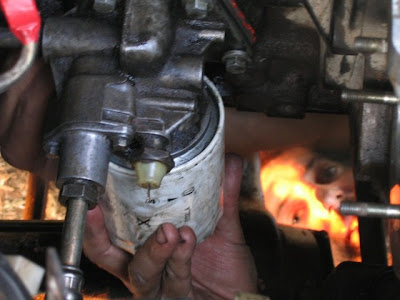
Yesterday morning we booked into a campsite, just off the beach and Gavin immediately set to disconnecting the fuel injector pump. Amazingly, nothing broke taking it out and today it is being fitted with a new O-ring at considerable cost- all of this for a blooming O-ring.

Thursday, 12 June 2008

"The Outback Starts Here"

We had one final errand to run before leaving Perth. Back in December when we replaced the front shock absorbers in Kenya, we had realised that the rear shocks were also due for replacement, and decided that we would get a new set in South Africa. We looked around in Cape Town, but couldn’t find the ones we wanted, so decided in the end to wait until we got to Australia. What we hadn’t counted on was that they are three times the price here. We considered having a pair shipped out from the UK, but although the shocks are cheaper, postage isn’t so it wasn’t worth it. We finally found the one store in Perth that had a pair in stock, so it was there that we headed before our Grande Departe.

It was mid afternoon on Saturday before we were actually on the road north. We had decided to follow the coast to Geraldton, and had spied a likely looking four-wheel-drive track to try things out on. Our first night out of Perth we stayed in the luxury of a caravan park at Ledge Point. The next morning saw us in Lancelin, looking for the start of the track. After a couple of wrong turns some local lads set us right. The track was sandy but firm, and was great fun. At one point we came across a stranded Toyota Hilux that had broken down in the middle of the track. The driver was about to call out the RAC for a tow, but after suggesting a couple of things we narrowed it down to his fuel filter and got him on his way.

After a no-horse town called Wedge the track became almost non-existent, but we plugged on. At one stage we were out on the beach with only a narrow strip of sand to drive on between the dunes and the tide.
Soon enough we turned inland again and the track became better defined once more, and eventually led us to the sealed road. Carrying on north, we found a great campsite at Sandy Cape.

It started raining overnight, and was quite stormy by the morning. We decamped to try and find a sheltered spot for breakfast, luckily finding a covered picnic table at Green Head. We still got wet though, while we waited for our porridge to cook.


From there it was a long drive through to Geraldton for lunch by the waterfront. From Geraldton, we planned to head east into the outback, so decided that now would be the best time to have a go a replacing the rear shocks, just in case anything else should need replacing at the same time. We have had so many stubborn fixings break when replacing parts in the past, and this time was no exception. I had already sprayed the fixings with GT85 lubricant well in advance to let it soak in and try and free things up, but sure enough, when trying to undo the top mount for the first shock the fixing sheared off. Unfortunately the fixing is not just a simple bolt, but required a whole new mounting. So once again, Catkin got to spend the rest of the day traipsing around the industrial areas trying to find the local Land Rover garage. Luckily, and thanks to some very helpful people, she did find one, and even more luckily they just happened to have one of what we needed in stock. Apparently they had ordered one in for a customer who had never picked it up. Catkin arrived back at the carpark over two hours after she had left, but with the required part in hand. By this stage it was too late to carry on, so with the old shock well and truly wired on to what was left of the mounting we went to find a campground for the night.

The following day we started again, taking even greater care with the top fixing on the other side of the vehicle. Fortunately this time it came off with out breaking, much to my relief. After this the whole job was completed relatively quickly, and we finally had our new shocks on. The improvement in the rear suspension was immediately noticeable.

Once that was done we were clear to go. We stopped on the way out of town to top up our fuel and water tanks, as well as filling up the jerry cans on the roof rack. With about 100 litres of water and 230 litres of diesel, as well as enough food to last for about three weeks or more, we were carrying more weight than we ever had before. We drove about 100km inland and found a great campsite beside a watering hole.

On the road between Yalgoo and Mt Magnet the next day we were waved down by an Aboriginal family in a V6 Commodore that wouldn’t go. We gave them a jump start which got them a few kilometres down the road before their car again stopped. In the end we towed them for about 60km to Mt Magnet, where they could have the car looked at. I think the guy was well and truly over looking at our spare tyre on the back door by the time we got there. All the way we were passed by the massive Road Trains.


Since then we have carried into ‘the interior’ and have reached Wiluna. There’s not much here, but now we have to decide where we head to next, based on track conditions, the weather forecast and local advice. It’s likely that we will be heading into some pretty remote areas for two or three weeks, so we probably won’t be able to update the blog for a while, even by text. Don’t worry though Mum, we bought a personal EPRIB before we left Perth, so if everything goes wrong we can at least set it off and await rescue.